Sourcing Outdoor wicker swing chairs in 2026 requires more than comparing photographs and factory prices. Buyers must connect market evidence with practical product inspection. Grand View Research identifies outdoor furniture as a growing global category, supported by residential improvements, hospitality projects, and demand for flexible outdoor living. Its market outlook also highlights material durability and design differentiation as important competitive factors.
Demand is rising, but sourcing mistakes remain expensive. A chair may look elegant in a showroom, then develop fading, rust stains, or loose weaving after one humid season. During factory evaluations, check the wicker’s UV resistance, frame alloy, weld quality, hanging hardware, cushion stitching, and maximum supported load. Ask suppliers for test records, material specifications, factory certifications, and recent production photographs. These details provide stronger evidence than polished catalog pages.
IMARC Group’s outdoor furniture market analysis also links growth with e-commerce, lifestyle upgrades, and hospitality expansion. That trend creates opportunities for private-label buyers, yet it can encourage rushed purchasing. Request a pre-production sample and test its swing movement on an uneven floor. Measure carton dimensions carefully; oversized packaging can quietly damage landed margins. Confirm minimum order quantities, replacement-part policies, lead times, and inspection procedures before signing terms.
No report replaces direct verification. Supplier claims can be incomplete. This guide may overlook a regional preference or a newer recyclable material. That is worth admitting. Reliable sourcing combines industry data, documented testing, transparent communication, and repeated sample checks. In 2026, the best Outdoor wicker swing chairs will not simply photograph well; they will arrive safely, support everyday use, and retain their appearance beyond the first season.
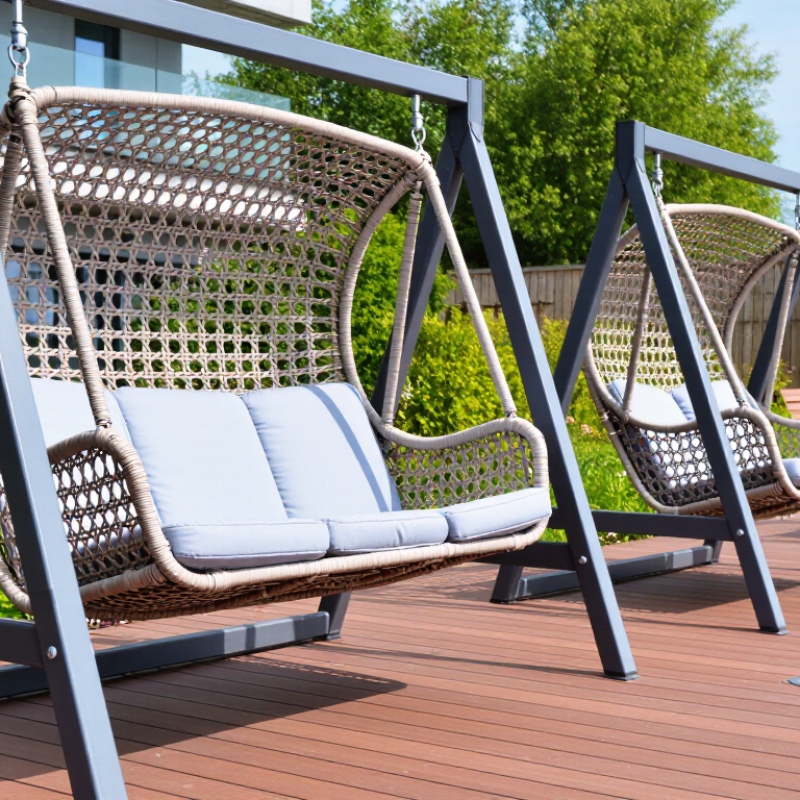
Define Outdoor Wicker Swing Chair Requirements and Buying Goals
Before sourcing an outdoor wicker swing chair, define who will use it and where it will stand. Begin with the user, not the catalog. A quiet balcony needs a narrower chair than a family patio. Record the available width, ceiling height, hanging point, and walking clearance. Set a target load capacity with a sensible safety margin. A chair for daily reading needs different support from one used occasionally by children.
Specify the materials in practical terms. Weather-resistant wicker should cover a stable aluminum or treated steel frame. Ask whether the weave resists fading, moisture, and cracking after repeated sun exposure. Check the cushion fabric, zipper quality, drainage, and drying time. I prefer removable covers because real patios collect dust quickly. However, “water-resistant” does not mean waterproof. That distinction is often overlooked.
Your buying goal should include comfort, service life, maintenance, and landed cost. Request product drawings, packing dimensions, assembly instructions, test reports, and clear load data from each supplier. Inspect a sample for loose weaving, sharp frame edges, uneven coating, and unstable suspension hardware. Sit in it for fifteen minutes, not two. That reveals pressure points. Supplier answers should be specific and consistent. Still, no specification predicts every outdoor condition. I once underestimated wind exposure on a covered terrace. The chair looked suitable, but its swinging range required more clearance than expected. Recheck the site before confirming the order.
Evaluate Wicker Materials, Frames, Cushions, and Weather Resistance
2026 How to Source Outdoor Wicker Swing Chairs?
Evaluate Wicker Materials, Frames, Cushions, and Weather Resistance
A reliable sourcing review starts with the wicker, not the showroom color. Check whether the strands are UV-stabilized resin or natural fiber. Resin wicker usually handles sunlight and moisture better. Ask for thickness, weaving density, and laboratory test records. Pull several strands gently. Loose strands suggest weak finishing.
Inspect the frame from underneath. Powder-coated aluminum resists rust and keeps the chair relatively light. Steel may provide strength, but exposed cuts can corrode quickly. Check welds, drainage holes, hanging points, and load testing documents. The suspension chain should move smoothly without sharp edges. A small defect here can become a serious safety concern.
Cushions need equal attention. Look for quick-dry foam, breathable covers, and concealed zippers. Press the seat repeatedly and check whether it recovers its shape. Request colorfastness and water-repellent test results, but do not trust paperwork alone. Place a sample outdoors for several weeks. Record fading, mildew, water pooling, and frame noise after rain.
Supplier consistency matters. Compare three samples from different production batches. Measure seat width, basket depth, and hanging hardware. Minor differences are normal, but large variations reveal weak quality control. I have found visual checks insufficient; photographs often hide poor drainage. A written inspection standard protects the buyer, although it may still need revision after real weather exposure.
2026 How to Source Outdoor Wicker Swing Chairs? - Evaluate Wicker Materials, Frames, Cushions, and Weather Resistance
Use the ratings as sourcing benchmarks. Actual performance depends on resin quality, UV stabilizers, frame coatings, drainage, assembly, climate, and maintenance.
| Wicker / Frame Configuration |
Wicker Material Evaluation |
Frame Evaluation |
Typical Weather Resistance |
UV Resistance |
Moisture Resistance |
Maintenance Level |
Key Sourcing Checks |
UV-Stabilized PE Wicker
Powder-Coated Aluminum Frame
|
High-density polyethylene strands are commonly selected for outdoor furniture because they are lightweight, moisture-resistant, and available in flat, half-round, or round profiles.
|
Aluminum does not rust and provides a favorable strength-to-weight ratio. A properly applied powder coating helps protect the surface from oxidation and abrasion.
|
High |
High with UV additives |
High |
Low |
Request resin type, UV package, colorfastness test data, wall thickness, frame alloy, coating thickness, weld quality, and drainage openings.
|
PE Wicker
Galvanized or E-Coated Steel Frame
|
PE provides good resistance to rain and humidity. Darker colors may absorb more heat, so heat distortion and color stability should be checked for hot climates.
|
Steel offers high rigidity and load-bearing potential but is heavier than aluminum. Zinc protection, e-coating, sealed welds, and intact top coating are important for rust prevention.
|
Medium to High |
High with UV additives |
Medium to High |
Medium |
Verify zinc coating or e-coat coverage, weld sealing, salt-spray test results, frame-wall thickness, and corrosion protection at drilled holes.
|
PE Wicker
Hardwood Frame
|
Outdoor-grade PE is generally more weather-tolerant than natural wicker and can conceal much of the frame, but it still needs UV stabilization and proper ventilation.
|
Hardwood can provide a warm appearance and good rigidity, but it may absorb moisture, move with humidity changes, and require regular sealing or oiling.
|
Medium |
High for PE; varies for wood finish |
Medium |
Medium to High |
Confirm wood species, moisture content, preservative treatment, end-grain sealing, fastener material, and replacement-finishing instructions.
|
PVC Wicker
Powder-Coated Steel Frame
|
PVC is water-resistant and economical, but lower-grade formulations can become brittle, fade, or crack more quickly under prolonged UV exposure and temperature cycling.
|
Steel can be rigid and stable, but any coating damage or exposed weld can become a corrosion entry point, especially in coastal or humid environments.
|
Medium |
Medium; formulation-dependent |
High |
Medium |
Ask for UV stabilizer information, low-temperature flexibility, accelerated-weathering results, coating adhesion, and corrosion test data.
|
Natural Rattan or Reed Wicker
Treated Hardwood or Metal Frame
|
Natural fibers offer an authentic appearance but are more vulnerable to prolonged rain, high humidity, mold, and UV exposure. They are generally better suited to covered or sheltered areas.
|
Frame performance depends on the substrate. Treated wood needs finish maintenance, while metal requires effective corrosion protection and sealed connection points.
|
Low to Medium |
Low to Medium |
Low to Medium |
High |
Confirm whether the product is intended for indoor, covered outdoor, or fully exposed use; check mildew treatment, protective finish, drying requirements, and storage guidance.
|
Cushion and Comfort Specifications to Verify
| Component |
Recommended Benchmark |
Why It Matters |
Supplier Questions |
| Cushion Fabric |
Solution-dyed acrylic or another outdoor-rated, UV-resistant textile |
Solution dyeing places color throughout the fiber, improving resistance to fading compared with surface-only coloration. |
Request fiber composition, colorfastness results, abrasion performance, seam construction, and cleaning instructions. |
| Foam Core |
Quick-dry foam or reticulated foam for frequently exposed seating |
Open-cell structures allow water and air to pass through more readily than conventional closed or dense foam. |
Ask for foam density, recovery performance, drying time after saturation, compression testing, and replacement availability. |
| Cushion Construction |
Removable, zippered covers with reinforced seams and breathable lining |
Removable covers simplify cleaning and replacement. Breathability helps reduce trapped moisture and odor. |
Check zipper corrosion resistance, seam strength, cover shrinkage, spare-cover options, and wash-care limits. |
| Drainage and Storage |
Slatted or perforated seating surfaces, drainage gaps, and a fitted protective cover |
Drainage reduces standing water, while ventilation and protection can extend the service life of wicker, cushions, and coatings. |
Confirm drainage design, cover breathability, wind-retention method, off-season storage dimensions, and maximum recommended exposure. |
Pre-Order Quality-Control Checklist
- Confirm the stated static load, recommended user capacity, suspension-point strength, and safety factor for the complete chair assembly.
- Inspect wicker for consistent spacing, secure wrapping, smooth edges, minimal exposed cuts, and no sharp protrusions.
- Check that the frame is level, welds are continuous where required, fasteners are corrosion-resistant, and moving joints operate without excessive play.
- Request material samples and compare color, strand profile, texture, odor, flexibility, and finish consistency with the approved sample.
- Test the complete product for drainage, cushion drying, coating adhesion, swing stability, noise, and packaging protection before mass production.
- For coastal or high-humidity markets, prioritize corrosion-resistant hardware, sealed welds, breathable covers, quick-drying cushions, and a documented maintenance schedule.
Verify Product Quality, Safety Standards, Customization, and Samples
When sourcing outdoor wicker swing chairs in 2026, treat quality as measurable evidence, not attractive photography. Grand View Research estimates the global outdoor furniture market could reach about USD 34 billion by 2030. That growth increases supplier choices, but also makes verification harder. Request material specifications for the wicker, frame, fasteners, coating, and cushions. Ask whether the resin wicker resists UV exposure, moisture, and repeated temperature changes. A sample should remain stable after outdoor weathering tests, not only look perfect on arrival.
Safety requires practical testing. Confirm the chair’s rated load, suspension-point strength, weld quality, and swing-cycle performance. For suspended seating, ask the laboratory to apply static and repeated dynamic loads based on the chair’s intended use. Relevant outdoor-furniture requirements may include EN 581, while ISO 12100 can guide risk identification during design. Standards must match the destination market. A supplier saying “passed testing” is not enough. Request the test date, model number, laboratory scope, and failure limits. Small details matter. Sharp edges matter.
Customization should be approved through a signed specification sheet. Record frame dimensions, wicker color, cushion density, fabric composition, logo placement, packaging, and replacement-part requirements. Use a pre-production sample, then compare mass production against that approved sample. ISO 2859-1 sampling methods can support batch inspection, although they do not replace safety testing. I would also inspect five unpacked chairs personally; cartons can hide loose bolts and uneven weaving. My earlier mistake was trusting one perfect sample. Suppliers can improve samples deliberately. Schedule a second inspection.
Negotiate Pricing, Shipping Terms, Inspection, and Long-Term Supply
2026 How to Source Outdoor Wicker Swing Chairs?
Sourcing outdoor wicker swing chairs requires more than comparing unit prices. Grand View Research reports continued growth in the global outdoor furniture market, increasing pressure on reliable capacity and weather-resistant materials. Request a cost breakdown for the frame, PE wicker, cushions, packaging, labor, and tooling. Negotiate with annual volume forecasts, not vague promises. A small deposit can secure production slots, but staged payments protect cash flow.
Use Incoterms 2020 clearly. Confirm whether the quote is FCA, FOB, or CIF, and define responsibility for loading, insurance, port charges, and delays. UNCTAD’s Review of Maritime Transport 2024 recorded 2.4% growth in maritime trade during 2023. Capacity can tighten quickly. Ask for carton dimensions, container loading plans, and a shipping tolerance. My mistake in one project was trusting estimated loading quantities. The final cubic volume was higher.
Tips: Approve a golden sample before mass production. Check welds, hanging hardware, wicker tension, cushion stitching, and carton compression. A third-party inspection should verify dimensions, appearance, function, and random load-test results. Set an agreed defect limit, but do not treat AQL as a substitute for judgment. Outdoor products face moisture, sunlight, and careless handling. Arrange pre-shipment inspection, then review the first two deliveries closely. For long-term supply, agree on material substitutions, spare-part support, lead times, and quarterly quality reviews. Keep written records. Memories become unreliable.
Conclusion
Sourcing Outdoor wicker swing chairs in 2026 requires a clear understanding of your project goals, target customers, budget, and intended usage environment. Begin by defining key requirements such as chair size, weight capacity, hanging method, design style, comfort level, and expected order volume. Carefully evaluate wicker materials, frame construction, cushion fabrics, finishes, and resistance to moisture, sunlight, temperature changes, and daily wear. These factors directly affect product durability, maintenance needs, and customer satisfaction.
Next, identify reliable suppliers with suitable manufacturing capabilities, stable production systems, and experience handling outdoor furniture orders. Compare their quality controls, customization options, safety practices, sample procedures, and ability to meet packaging and delivery requirements. Before placing a large order, review samples and confirm specifications in writing. Finally, negotiate pricing, payment terms, shipping arrangements, pre-shipment inspections, defect handling, and after-sales support. Establishing clear standards and communication from the beginning can help secure consistent quality and build a dependable long-term supply relationship.
 ATC Furniture